
সংবাদ শিরোনাম : Cleanliness Drive and Awareness Rally Held in Lichubagan to Prevent Dengue in Rangunia.
Staff Reporter
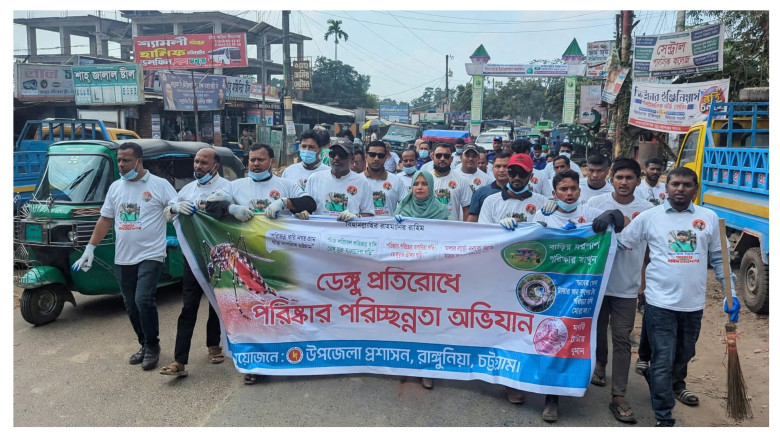
A special cleanliness drive and an awareness rally were held in Lichubagan, one of the major commercial areas of Rangunia Upazila in Chattogram, to prevent dengue and promote public awareness about maintaining a clean environment. The programme was organised through a joint initiative involving the local administration, business community, humanitarian and social organisations, and local youth.
With the slogan, “Let Us Keep Our Surroundings Clean and Stay Healthy Together,” the initiative aimed to eliminate potential breeding grounds for Aedes mosquitoes, raise public awareness about dengue prevention, and encourage residents and business owners to maintain cleanliness in their surroundings. The programme also focused on removing waste from market areas and public places to help create a healthier environment.
The programme began on Saturday morning, October 10, along the main road and at important points in the Lichubagan area. An awareness rally was organised at the beginning, highlighting the importance of dengue prevention, controlling mosquito breeding, and keeping the environment clean. A cleanliness drive was subsequently conducted from morning until noon in different parts of the area.
The cleanliness campaign was inaugurated by Khandaker Naznin Setu, Assistant Commissioner (Land). Haji Elias Sikder, Joint Convener of Rangunia Upazila BNP, and Shoaib Kader, General Secretary of the Chandraghona Lichubagan Traders Association, led the field activities from the beginning.
Local leaders and activists from BNP, Jubo Dal, Swechchhasebak Dal, Chhatra Dal, and other organisations participated in the programme. Imran Hossain, Convener of the Rangunia Upazila unit of the Bangladesh Red Crescent Society, was also among those involved in the initiative.
As part of the campaign, waste and litter were removed from various narrow streets, roadside areas, the surroundings of shops, and other public spaces. The organisers also undertook cleaning activities in drains and other places where water could accumulate. Locations that could provide suitable breeding conditions for Aedes mosquitoes were identified, and necessary cleaning measures were carried out.
Participants emphasised that medical treatment alone is not enough to prevent dengue. Effective prevention requires eliminating mosquito breeding grounds and reducing environmental conditions that allow mosquitoes to multiply. They stressed that individuals, families, business establishments, the local administration, and social organisations must work together to achieve this goal.
At a brief discussion meeting following the rally, speakers said that creating a clean and dengue-free area cannot be achieved through a single day's programme. Rather, it requires regular cleanliness activities and responsible behaviour from every citizen. They called for maintaining cleanliness in residential yards, markets, educational institutions, business establishments, and public gathering places.
The speakers also pointed out that water accumulated in rooftop containers, flowerpot trays, discarded tyres, plastic bottles, coconut shells, and unused containers can create potential breeding grounds for Aedes mosquitoes. They urged residents to inspect such places regularly and remove stagnant water. Particular attention should be given to checking homes and business premises after rainfall to ensure that water does not remain accumulated.
Public awareness was another major focus of the programme. According to the speakers, people should not only keep their own homes clean but also take responsibility for their neighbourhoods and surrounding environment. They stressed the importance of removing stagnant water promptly, disposing of waste in designated places, and avoiding the dumping of rubbish into drains and sewers.
Regular implementation of these measures can help reduce mosquito breeding grounds while improving the overall cleanliness of the area.
Local business owners and volunteers noted that Lichubagan is an important commercial centre visited daily by a large number of people. Maintaining cleanliness in the market is therefore essential not only for traders but also for customers, pedestrians, and local residents.
They urged shopkeepers to prevent waste from accumulating in front of their establishments, dispose of used packaging and plastic materials properly, and clean their surroundings before closing their shops.
Leaders of the local traders' welfare association, representatives of different political organisations, public representatives, sanitation workers, and members of various social and voluntary organisations participated spontaneously in the campaign. Their collective efforts helped carry out cleaning activities at several locations throughout the market area.
Local traders and residents welcomed the initiative and praised the efforts of the administration and participating organisations. They observed that coordinated initiatives of this kind can increase public awareness and encourage greater community participation in cleanliness activities.
However, they also emphasised that regular monitoring and continued public cooperation are necessary to sustain the benefits of the campaign.
Residents and business owners expressed their commitment to keeping Lichubagan clean in the future. They pledged to use dustbins in shops and public places, dispose of waste properly, and avoid littering roads and other open spaces.
According to those involved in the programme, cleanliness campaigns are an important step towards preventing dengue and raising public awareness. However, achieving lasting results requires regular removal of stagnant water, continuous cleaning of potential mosquito breeding grounds, and sustained public awareness activities.
They expressed hope that continued cooperation among the local administration, business community, social organisations, and residents would help maintain a cleaner environment in Lichubagan and strengthen efforts to reduce the risk of dengue.