
সংবাদ শিরোনাম : Global Biodiversity Targets Off Track, UN Raises Concerns Ahead of COP17.
Staff Reporter | AdChannel24.com
Publication Date: October 18, 2026
Global efforts to protect plants, animals and natural ecosystems are falling short of expectations. The United Nations has raised concerns that fewer than half of the national targets set for biodiversity conservation are on track for implementation. Amid climate change, deforestation, shrinking natural habitats and increasing human pressure on the environment, the need to strengthen global biodiversity conservation efforts has become increasingly urgent.
According to a report published by the United Nations Office at Geneva on October 15, less than half of the national targets established to protect plants, animals and ecosystems are showing promising progress toward implementation. This situation has raised a critical question for the international community: How effectively are countries translating their commitments to biodiversity conservation into concrete action?
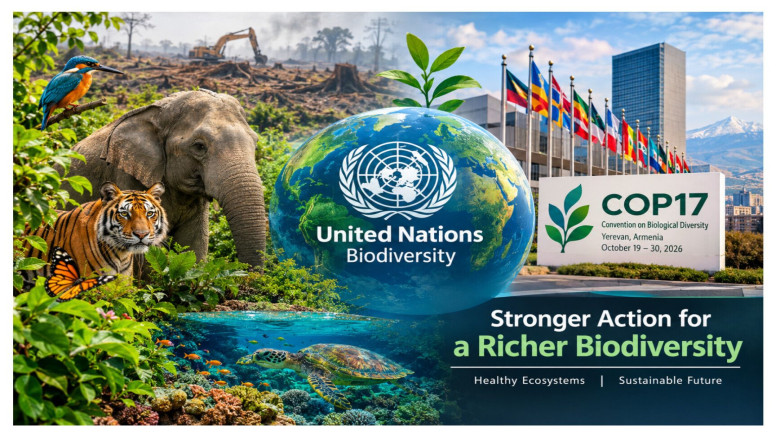
Against this backdrop, the 17th meeting of the Conference of the Parties to the Convention on Biological Diversity, known as COP17, is scheduled to begin on October 19 in Yerevan, the capital of Armenia. The conference is expected to continue until October 30. Representatives from different countries will review progress in biodiversity conservation and discuss the steps needed to strengthen future efforts.
According to the Convention on Biological Diversity (CBD), this conference is particularly important because it will provide an opportunity for the first global review of collective progress in implementing the Kunming–Montreal Global Biodiversity Framework. The framework aims to achieve significant progress in protecting nature and biodiversity by 2030.
The world's natural resources and biodiversity are closely connected to food production, access to clean water, medicine, agriculture and economic activities. Damage to forests, rivers, wetlands, oceans and other natural environments does not affect only wildlife and plant species. It also threatens human livelihoods, food security and overall well-being.
One of the longstanding concerns among experts is the destruction of natural habitats, which is putting the survival of many species at risk. Agricultural expansion, urbanization, deforestation, pollution and climate change are placing increasing pressure on ecological balance in different parts of the world. As a result, declaring protected areas alone is not enough. Effective management of these areas and development practices that are compatible with nature are equally important.
The United Nations' assessment of national progress highlights the growing gap between international commitments and implementation on the ground. Even when a country adopts a biodiversity conservation plan, the expected results may remain out of reach without adequate funding, skilled personnel, effective monitoring systems and strong enforcement of environmental laws.
For this reason, identifying barriers to implementation will be an important part of the discussions in Yerevan. International discussions may focus on the measures taken by individual countries, the areas where progress remains insufficient and the steps required to address these gaps. However, the final decisions and any new commitments from the conference will need to be confirmed through official announcements.
Under the Kunming–Montreal Global Biodiversity Framework, countries are expected to develop national biodiversity strategies, establish targets and submit progress reports. According to information published by the CBD in March 2026, 125 countries had submitted their seventh national reports by the specified deadline. These reports are considered an important source of information for assessing progress at the global level.
However, submitting a report and achieving measurable improvements in nature are not the same thing. A country's plan may include forest conservation, wetland restoration and the protection of endangered species, but its actual results must also be assessed. Monitoring protected forests, species populations, habitat changes and pollution control can help provide a clearer picture of progress.
Financing is another major factor in biodiversity conservation. Many developing countries need sufficient financial resources and technical expertise to implement conservation programmes, conduct research, adopt new technologies and involve local communities. International cooperation, technology transfer and appropriate financial assistance can play an important role in addressing these challenges. At the same time, transparency in the use of funds is essential to ensure that financial support produces tangible conservation benefits.
Biodiversity conservation is also highly important for Bangladesh. The Sundarbans mangrove forest, coastal regions, rivers, haors, wetlands and hill forests provide habitats for numerous plant and animal species. These natural environments also help reduce the impacts of cyclones and storm surges, protect fish breeding grounds and support the livelihoods of local communities.
Protecting forests and wetlands, safeguarding wildlife habitats, controlling plastic and other forms of pollution, and ensuring environmentally responsible development are therefore essential priorities for Bangladesh. Local communities must also be involved in conservation initiatives, as long-term success is difficult to achieve without the participation of people who depend on natural resources for their livelihoods.
Governments are not the only actors responsible for achieving international biodiversity targets. Researchers, environmental organizations, businesses and ordinary citizens also have important roles to play. Preventing the destruction of forests and wetlands, improving waste management, using natural resources responsibly and complying with environmental laws can collectively contribute to meaningful change.
The United Nations' warning highlights a fundamental point: announcing commitments to protect nature is not enough; countries must also deliver measurable results. As the COP17 conference approaches in Yerevan, the international community will be watching to see whether the review of national progress and discussions on future measures can generate fresh momentum toward achieving global biodiversity goals.
Sources: United Nations Office at Geneva (UN Geneva), October 15 and 18, 2026; Convention on Biological Diversity (CBD), official COP17 information and publications on national reporting in 2026.