
 Sanjida Yasmin Shanta
Faridpur Correspondent
Publication date:14 October 2026
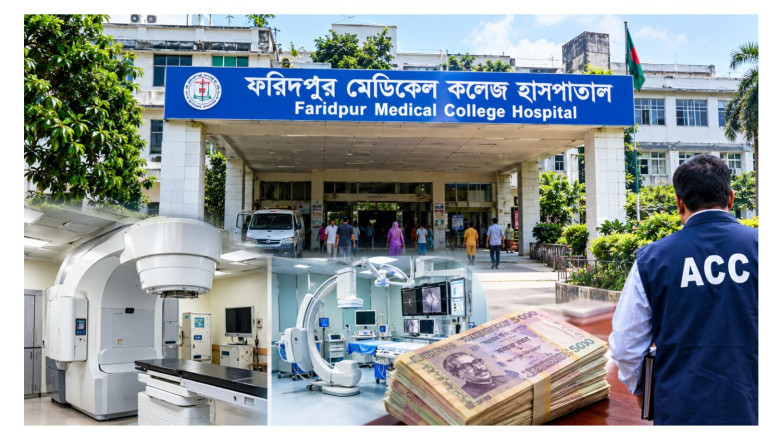
Two major pieces of medical equipment purchased for approximately Tk 233.8 million remain unused at Faridpur Medical College Hospital, raising questions about the use of public funds and the delivery of essential healthcare services.
A linear accelerator worth around Tk 145 million, purchased for cancer treatment, reportedly remains unused and boxed, while a catheterisation laboratory (cath lab) installed at a cost of Tk 88.8 million has yet to become operational, despite being installed nearly nine years ago.
The Anti-Corruption Commission (ACC) has identified these issues during an investigation into alleged irregularities at the hospital.
According to ACC officials, a two-day operation uncovered information relating to the prolonged non-use of expensive medical equipment, irregularities in the procurement of medical supplies, the handling of ambulance revenue, outsourced recruitment and patient services. The commission collected relevant documents for further examination and said legal action would be considered after reviewing the evidence.
At a press briefing held in Faridpur on Tuesday night, October 13, officials outlined the findings of the operation, which began on Monday, October 12. They said the collected documents would be examined to determine whether any individuals or institutions were responsible for the alleged irregularities.
Mohammad Mostafizur Rahman, an assistant director of the ACC's Faridpur District Integrated Office, presented details of the operation. He said the investigation had been conducted under instructions from the commission's headquarters to examine allegations involving hospital services, procurement and administrative activities.
One of the most significant issues concerns two major equipment purchases made during the 2016–17 fiscal year.
During that period, a linear accelerator costing approximately Tk 145 million was purchased for the hospital's cancer unit. A linear accelerator is used to deliver radiation therapy to cancer patients. However, according to information gathered during the ACC operation, the equipment could not be put into operation because the necessary infrastructure had not been adequately prepared.
As a result, the expensive machine has reportedly remained unused for years.
The prolonged non-use of such equipment raises concerns about the planning and implementation of public healthcare projects. Radiation therapy is an important component of cancer treatment, and installing the necessary equipment at a public hospital can help patients access specialised treatment at comparatively affordable costs.
However, when equipment is purchased without ensuring the necessary infrastructure, staffing and operational arrangements, the intended benefits may not reach patients.
Another major concern involves a cath lab installed in the hospital's cardiology department at a cost of approximately Tk 88.8 million during the same fiscal year.
A cath lab is used for various diagnostic and interventional procedures related to heart disease. Despite the substantial investment, the facility reportedly remained non-operational nearly nine years after installation, according to information cited by the ACC.
The commission's officials said the full payments had been made to the two contractors involved in the equipment projects, even though the machines had not become fully operational. This has raised questions about the procurement process, verification of completed work and the procedures followed before releasing payments.
However, the precise responsibilities of the individuals or institutions involved will need to be established through further examination of the documents and the investigation process.
The ACC also found information indicating possible irregularities in the procurement of medical supplies.
Medical supplies and reagents are essential for the day-to-day functioning of a hospital, including the provision of medicines, diagnostic materials and other necessary items. According to the commission, inconsistencies were identified in procurement-related records, prompting officials to collect relevant documents for verification.
Transparency in public hospital procurement is essential because medical supplies directly affect patient care. Discrepancies between procurement records, the quantities delivered and the materials actually received can undermine hospital services and raise questions about the use of public money.
The ACC has therefore taken steps to examine the relevant records and establish the actual circumstances.
The handling of revenue from government ambulances also came under scrutiny during the operation.
According to preliminary information cited by the commission, the hospital had five government ambulances. Two were reportedly out of service, while the remaining three were operational.
However, officials said they could not find records showing that revenue collected from the operational ambulances during the preceding month had been deposited into the government treasury. The ACC collected relevant documents to determine whether the matter involved financial irregularities, accounting discrepancies or other explanations.
Government ambulances play an important role in transporting patients, particularly those requiring urgent medical attention. Revenue generated from their use must be properly recorded and deposited in accordance with applicable rules.
The commission's examination of this issue is expected to help clarify whether the relevant financial procedures were followed.
The ACC also examined allegations involving outsourced recruitment and patient services at the hospital.
The allegations included claims that patients were harassed and directed to private clinics and diagnostic centres through intermediaries. Officials collected administrative records and other relevant documents to assess the claims.
Such allegations are particularly significant because many patients depend on public hospitals for affordable medical care. If patients face harassment or are improperly directed towards private facilities, their access to treatment may be affected.
Nevertheless, the allegations must be assessed through a proper investigation before any conclusions can be drawn about the responsibility of particular individuals.
The ACC operation began at 10:00 am on Monday, October 12, and continued until 8:00 pm on Tuesday, October 13. An eight-member team participated in the operation.
The commission said the collected records would be analysed to determine whether irregularities occurred in procurement, equipment installation, financial transactions or administrative activities. Further legal action may follow if sufficient evidence establishes wrongdoing.
The hospital administration's response is also relevant to understanding why the equipment remains unused.
According to published reports, Dr. Monosh Krishna Kundu, the hospital's acting director, said the administration had cooperated with the investigation and had previously informed the ministry about the unused equipment.
His statement highlights the need to examine the planning and implementation of the projects, including infrastructure readiness, administrative decisions and the reasons the equipment could not be brought into service.
The prolonged non-use of medical equipment purchased with public funds is not merely a financial management concern. It also affects the public's access to healthcare.
When expensive equipment remains idle, the intended benefits of public investment are delayed or lost. Patients who might otherwise receive specialised treatment at a public hospital may have to seek services elsewhere.
The ACC's next task is to examine the collected documents, identify the nature of any irregularities and establish whether specific individuals or institutions bear responsibility. It is also important to assess whether the equipment can be made operational by providing the necessary infrastructure, personnel and technical support.
The findings may help determine what corrective measures are required and how similar situations can be prevented in future public healthcare projects.
The commission has said that further legal steps will be considered after reviewing the documents and determining responsibility. Until the investigation is completed and the relevant allegations are established through the appropriate legal process, they should not be treated as proven criminal offences.
The case has nevertheless renewed attention on the need for accountability in public procurement, the proper use of government funds and the timely delivery of essential healthcare services.